

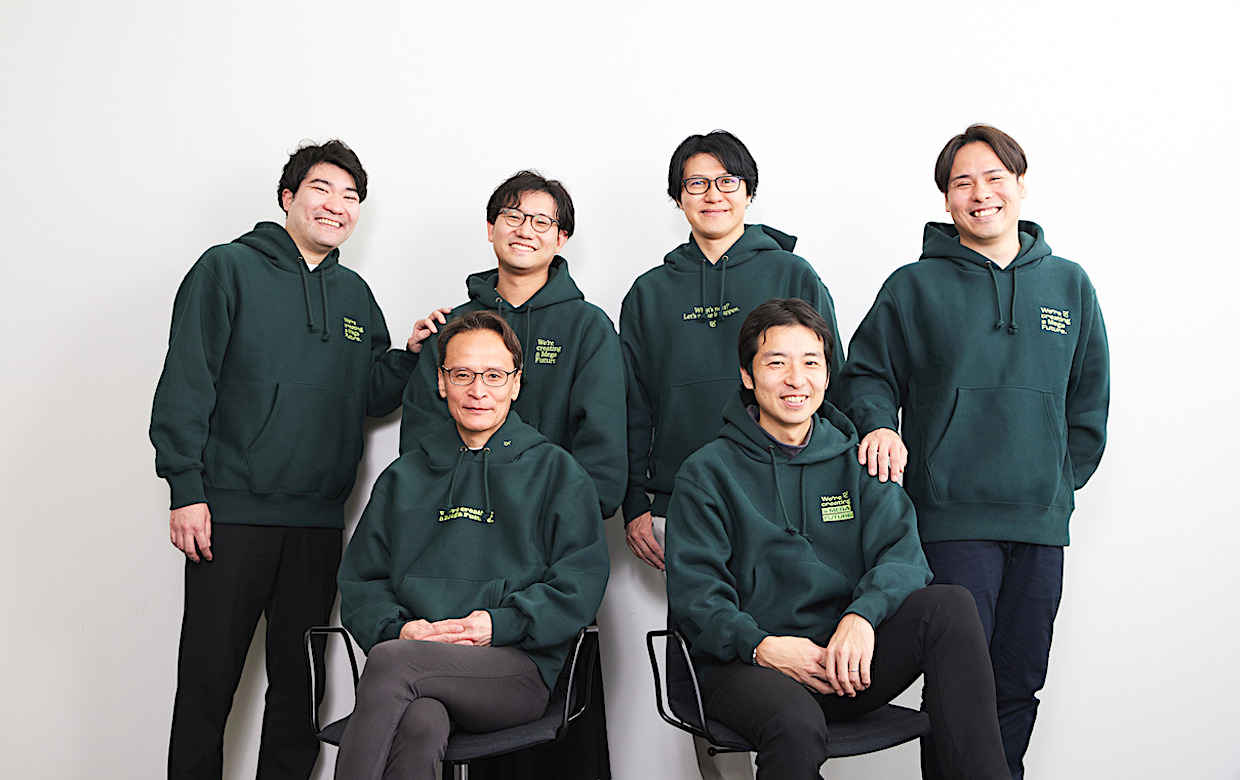
Front row from left: Hiroaki Yoshikawa (Representative Director of SMBC Edge, General Manager of Growth Business Development Department at SMBC), Takuya Ishizawa (General Manager of Planning Department, SMBC Edge)
Back row from left: Ryota Iwama (Academia Collaboration, SMBC Edge), Ryo Kojima (Business Development, SMBC Edge), Tomohiro Miyasaka (Chief Investment Officer, SMBC Edge), Yuta Nakamura (Business Development, SMBC Edge)
Photo credit: SMBC Edge
In October 2025, Sumitomo Mitsui Financial Group (SMFG) officially launched a new venture capital firm, SMBC Edge. With a dual model of “investment + business development” that sets it apart from traditional VCs, the firm aims to transform Japan’s industrial structure itself.
Takuya Ishizawa, General Manager of Planning at SMBC Edge, who has devoted 14 of his 18 years as a banker to supporting startups, explains: “We deliberately made this organization not look like a venture capital firm.” The company name intentionally omits words like “venture capital” or “fund,” keeping it simple. Instead, by defining themselves as an “Industrial Creation VC,” they make clear their commitment to go beyond mere investment.
The organization of approximately 20 people, centered around Tomohiro Miyasaka who oversees the investment division, and Yuta Nakamura who leads the business development division, brings together professionals with proven track records in their respective fields.
Why is a megabank now committing seriously to startup support? We explore their strategy, determination, and potential ripple effects on the Japanese economy.
Why a Bank-Affiliated VC Champions “Industrial Creation”

Photo credit: Growthstock Pulse
I thought we should create an organization that leverages SMBC’s position to conduct work with industrial impact. As Japan is said to be in decline, there should be a movement to revive the economy from finance. (Ishizawa)
Not “backing winners,” but “creating winners.” The concerns Ishizawa developed through his years of startup support experience directly inform SMBC Edge’s concept. SMBC Edge’s mission is “Realizing Japan’s Regrowth Through the Creation of New Industries.” Behind their self-designation as an “Industrial Creation VC” lies a sense of crisis about the Japanese economy as a whole.
The basic function expected of financial institutions is ‘fundraising.’ However, creating new businesses and industries cannot be done with money alone. Human resources, business strategy, M&A, PR strategy—we believed the organization we should aim for is one that can provide comprehensive support at a high level across all of these. (Ishizawa)
To realize the philosophy of making invested money “flow with life,” SMBC Edge provides robust business development support simultaneously with investment execution. They’re prepared to venture into areas that traditional bank-affiliated VCs haven’t provided: human resources introductions, business strategy formulation, legal and PR support.
Beyond the “Sushi Boat” VC Model: SMBC Edge’s Founder-First Approach

SMBC Edge’s greatest distinguishing feature lies in its organizational design with both investment and business development functions as dual wheels. Their benchmark is Andreessen Horowitz (a16z) in the US, which is known for modeling itself after Hollywood talent agencies, thoroughly supporting founders after investment.
There’s a famous story about how a16z founders Marc Andreessen and Ben Horowitz were shocked by a comment from a major VC partner who said: “VC is like a sushi boat (conveyor belt sushi). You sit and wait for a large number of startups to flow by, and occasionally reach out to pick your investment targets.“
Viewing this passive approach as something to disrupt, rather than passively waiting for investment opportunities like traditional VCs, the two established an “entrepreneur-first” full-service platform that actively supports founders.
SMBC Edge also adopts the same philosophy as a16z. Rather than a style of ‘going after good investment opportunities when they come,’ we want to commit ourselves to business development and thoroughly support founders. (Ishizawa)
At the core of the organization are Tomohiro Miyasaka, who oversees the investment division, and Yuta Nakamura, who leads the business development division.
Miyasaka joined SBI Holdings as part of their first class of new graduates, then participated in launching an internet bank (now Sumishin SBI Net Bank), a joint venture between Sumitomo Trust Bank and SBI Group. From 2008, he handled domestic and international investments at GMO Venture Partners. Since 2020, he has been deeply involved in the management challenges of growth companies to prime-listed companies as an advisory board member, supporting domestic and international VCs and serving as a director of listed companies.
Meanwhile, Nakamura spent 10 years at For Startups. In the first 5 years, he supported CXO recruitment, and in the latter 5 years, he launched an open innovation business, creating multiple new businesses including a startup database and GRIC (Growth Industry Conference).
I’ve seen many startups stall due to “bottlenecks other than money”—unable to find a CXO after fundraising, unable to solidify business strategy, unable to develop sales channels. What we want to do is mobilize everything—people, strategy, networks—to solve our portfolio companies’ management challenges. (Nakamura)
The current organization of about 20 professionals brings together people with proven track records in their respective specialties. Nakamura, who oversees business development, explains SMBC Edge’s support approach this way:
We provide hands-on support for startups’ various management challenges—until recruitment is actually decided, participating in strategy formulation meetings every week, until PoC with large corporations gets running. In 10 years at For Startups, I’ve seen hundreds of startups, and without exception, successful companies have ‘execution capability.’ Supporting that execution is our job. (Nakamura)
Beyond fundraising, they have a structure capable of addressing all management challenges that startups face: business development, HR, governance, sales support, and more.
Investment targets cover the full scope in both stage and sector. Eventually targeting all of Asia, they cover a wide range from seed to later stage. What’s notable is that they operate SMBC Edge’s own fund, separate from the SMBC-GB Growth Fund (30 billion yen total≒190 million USD, established July 2023, jointly operated with Global Brain) and SMBC Asia Rising Fund (200 million USD, established April 2023, jointly operated with Incubate Fund).
SMBC Edge’s competitive advantage lies in SMBC Group’s assets and network: a nationwide network of branches covering individuals and corporations, offices across Asian countries, and access to large corporations, local governments, and the national government—these are strengths unique to bank-affiliated VCs.
At SMBC Edge, professional talent not originating from SMBC will engage with ecosystem builders such as large corporations, government, regions, and universities. If we can produce results, other megabanks will follow. That would create an even greater impact on the entire startup world. (Ishizawa)
In fact, there is a report that Mizuho Bank will also launch an industrial development fund of about 10 billion yen scale using its own capital within 2025. Targeting deep tech fields such as medical, materials, and space, they will provide support from the seed/early stage with a long-term perspective of 10 years. As megabanks get serious, Japan’s startup ecosystem is at a major turning point.
SMBC Edge’s focus isn’t limited to startup investment. They also play a role in corporate carve-outs and new business ventures from large companies, breaking down industrial silos and promoting global expansion. With many projects stalled due to regulations, SMBC’s influence can also be leveraged to work toward improving the regulatory environment.
Capturing Asia’s Demographic Dividend

CC0 Public Domain Image
SMBC Edge aims to open a Singapore base within this fiscal year. Miyasaka will go there to support both Japanese companies’ Asian expansion and Asian companies’ expansion into Japan.
The Asia expansion strategy is clear: invest in Japanese companies and comprehensively support their equity, debt, local partnerships, PoC implementation, acquisitions, and more when they expand into Southeast Asia. Conversely, they also bridge the gap when promising local companies enter the Japanese market. They also support Japanese major corporations’ acquisitions of local companies.
Southeast Asia has a small time difference with Japan, short travel distance, and similar culture. There’s also deep penetration of Japan-originated culture like anime. In that sense, we’re going after the demographic dividend in Asian regions where we share this “common language.” The region is currently in a market adjustment period, but I think the fundamentals remain solid. Of course, India is also in our sights. (Miyasaka)
This statement succinctly shows why they’re focusing on Asia rather than the US or Europe.
Another ambition of SMBC Edge is to change Japan’s work style itself.
Now is an era where professional expertise is more valued. A megabank, a symbol of traditional companies, actively employs mid-career professional talent as central figures. I think there’s meaning in this way of working spreading among major domestic companies. (Ishizawa)
Indeed, SMBC Edge’s organizational structure embodies this shift toward job-based employment. An organization of about 20 professionals functioning by leveraging their respective expertise. If this spreads throughout Japanese companies, labor mobility will change significantly.
What kind of chemical reaction will occur when a megabank, a massive organization, combines with startup agility? SMBC Edge’s challenge holds the potential to become a new model case for Japan’s industrial creation.
Continued to our next article: SMBC Edge Betting Billions Beyond Tokyo, Here’s Why It Might Work


 Growthstock Pulse